
(scroll down for English version)
El Valle Sagrado (Pisaq y Ollantaytambo) y Machu Picchu
Por la mañana del sábado nos encontramos con el guía, que para nuestra sorpresa era Karen con quien hicimos el “city tour”, y junto con 30 personas más salimos rumbo al Valle Sagrado. Las paradas eran en Pisaq, Ollantaytambo y Chinchero. La última parada no la haríamos con el grupo porque de Ollantaytambo salía nuestro tren hacia Aguascalientes, pueblo que se encuentra debajo de Machu Picchu.
El Valle Sagrado fue un lugar importante durante el imperio Inca por dos razones. Una razon era porque se creía que estaba alineado con la vía Lactea, y la segunda porque era uno de los centros claves de extracción de productos naturales, principalmente maíz y papa. Su nombre viene del Río Sagrado (Río Urumbamba, Río Vilnacota o Río Wilcamayu como también se le conoce) que corre a lo largo del valle.
El Valle Sagrado (Pisaq y Ollantaytambo) y Machu Picchu
Por la mañana del sábado nos encontramos con el guía, que para nuestra sorpresa era Karen con quien hicimos el “city tour”, y junto con 30 personas más salimos rumbo al Valle Sagrado. Las paradas eran en Pisaq, Ollantaytambo y Chinchero. La última parada no la haríamos con el grupo porque de Ollantaytambo salía nuestro tren hacia Aguascalientes, pueblo que se encuentra debajo de Machu Picchu.
El Valle Sagrado fue un lugar importante durante el imperio Inca por dos razones. Una razon era porque se creía que estaba alineado con la vía Lactea, y la segunda porque era uno de los centros claves de extracción de productos naturales, principalmente maíz y papa. Su nombre viene del Río Sagrado (Río Urumbamba, Río Vilnacota o Río Wilcamayu como también se le conoce) que corre a lo largo del valle.
 Nuestra primera parada fue Pisaq. Este complejo no se considera un lugar sagrado, sino más bien un lugar de intercambio comercial. Pachacutec (uno de los Incas de mayor influencia en el Imperio) lo construyó con el objetivo de controlar la ruta comercial entre Cusco y el Amazonas.
  Por las numerosas terrazas que rodean la ciudad, los arqueólogos han concluido que también era un importante centro de cultivo. Las terrazas tenían el objetivo de facilitar el cultivo, ya que de otra forma hubiera sido imposible sembrar por la inclinación de las montañas.
Otro dato interesante es que los arqueólogos han concluido que los Incas construían respetando las montañas y el medio ambiente, ya que preferían seguir la forma del terreno antes de demolerlo o destruirlo.
 Después de una parada para el almuerzo, llegamos a Ollantaytambo. También fue construido por órdenes del Inca Pachacutec para residencia personal y como centro ceremonial; pero nunca fue terminado. El contraste de los acabados de las construcciones son una muestra de que en la parte superior vivían los nobles mientras en la parte inferior donde estaban las terrazas, y las piedras están en bruto sin ningun acabado, era donde vivían los yanaconas quienes se encargaban de la siembra.
 Frente a las terrazas de Ollantaytambo hay una montana llamada Pincu Ulluna, donde se encuentran las colcas o graneros. Estas fueron construidas en esta montana y a esta altura para aprovechar las corrientes de aire fresco y conservar los productos naturales como el grano y algunos vegetales.
 Entre las colcas se puede distinguir la cara de una viejo, Tunupa, dios y protector de Ollantaytambo.
 Una de las construcciones que llaman la atención en este complejo es una pared formada por seis rocas inmensas. Estos bloques que pesan mas de 50 toneladas fueron traidos desde una montana bastante retirada; podria decir que por lo menos a 75 kilomentros y en el medio esta el Rio Urubamaba. Los arqueologos que han estudiado esta ciudad tienen varias teorias de como y porque lo hicieron, pero solo son teorias.
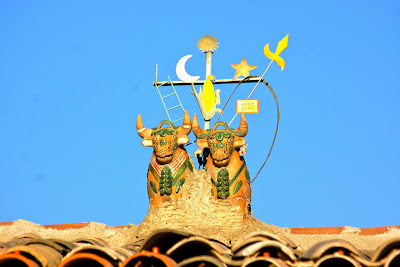
 Después de terminar la visita a las ruinas de Ollantaytambo, La Flaca y yo nos separamos del grupo y nos fuimos primero a la plaza del pueblo y luego a un café cerca de la estación ha esperar nuestro tren. Mientras estábamos en la plaza, pudimos de ver de forma mas clara, la tradición que tienen aquí de poner en el techo de las casas dos bueyes con una cruz. Esto significa buena suerte, fertilidad para los animales, y que la familia es católica. No todos tienen la cruz, pero todas las casas tienen los dos bueyes.
Después de una larga espera llego el tren y nos quedamos boquiabiertos con lo bien cuidado y mantenido que se encuentra. Llegamos Aguascalientes casi a las nueve de la noche y antes de acostarnos, arreglamos nuestro tour para Macchu Picchu al día siguiente.
El despertador sonó a las 5:00 am. Nos arreglamos y salimos rumbo al centro para buscar el camión que nos llevaría hasta la entrada de Machu Picchu, donde nos quedamos de ver con el guía. Desde que salimos del hostal, notamos que todas las montanas estaban cubiertas por las nubes. No era una buena señal ya que la ciudad de Machu Picchu esta allá en las alturas.
Llegamos a la entrada del complejo y vimos lo que temíamos; las nubes cubrían todo. Pero teníamos la esperanza de que cuando empezara el tour en una hora ya se hubiera despejado. Como lo leen, llegamos con una hora de anticipación. El tour iniciaba a las 8:00 y nosotros estábamos en la entrada, sentados en una banquita bastante incomoda, con frío y tapándonos del rocío de la mañana en un techito…y fue aquí, en este momento, donde me di cuenta que desde que perdí el control de mi horario, ósea desde que La Flaca tomo posesión de el, siempre llegamos tan temprano a todo que siempre estamos esperando. Me gustaba mas cuando a mi me esperaban.
A las 7:50 am, apareció nuestro guía y empezó a llamar por nombre a todos los miembros de su grupo y así alrededor de las 8:15 entramos a la antigua ciudad Inca que recibió el nombre de Machu Picchu (Montaña Vieja), ya que este es el nombre de la montaña donde esta localizada. La otra montaña que todos hemos visto en fotos es Huayna Picchu (Montaña Joven).
El primer turista en visitar esta ciudad fue el estadounidense Bingham en 1911. Se dice que es el primer turista porque los nativos de esta zona ya habían descubierto la llamada “Ciudad Perdida de los Incas” desde tiempo antes.
Después de entrar y caminar hacia la parte superior de la ciudad las nubes no se habían movido nada, al contrario, ya no se podía ver nada a 10 metros. La Flaca no estaba contenta, al igual que todos los demás turistas que hay nos encontrábamos, aunque para algunos ya era nuestra segunda vez visitando este lugar y ya habíamos visto esta ciudad en todo su esplendor.
El guía siguió adelante con las explicaciones e historia del lugar.
El despertador sonó a las 5:00 am. Nos arreglamos y salimos rumbo al centro para buscar el camión que nos llevaría hasta la entrada de Machu Picchu, donde nos quedamos de ver con el guía. Desde que salimos del hostal, notamos que todas las montanas estaban cubiertas por las nubes. No era una buena señal ya que la ciudad de Machu Picchu esta allá en las alturas.
Llegamos a la entrada del complejo y vimos lo que temíamos; las nubes cubrían todo. Pero teníamos la esperanza de que cuando empezara el tour en una hora ya se hubiera despejado. Como lo leen, llegamos con una hora de anticipación. El tour iniciaba a las 8:00 y nosotros estábamos en la entrada, sentados en una banquita bastante incomoda, con frío y tapándonos del rocío de la mañana en un techito…y fue aquí, en este momento, donde me di cuenta que desde que perdí el control de mi horario, ósea desde que La Flaca tomo posesión de el, siempre llegamos tan temprano a todo que siempre estamos esperando. Me gustaba mas cuando a mi me esperaban.
A las 7:50 am, apareció nuestro guía y empezó a llamar por nombre a todos los miembros de su grupo y así alrededor de las 8:15 entramos a la antigua ciudad Inca que recibió el nombre de Machu Picchu (Montaña Vieja), ya que este es el nombre de la montaña donde esta localizada. La otra montaña que todos hemos visto en fotos es Huayna Picchu (Montaña Joven).
El primer turista en visitar esta ciudad fue el estadounidense Bingham en 1911. Se dice que es el primer turista porque los nativos de esta zona ya habían descubierto la llamada “Ciudad Perdida de los Incas” desde tiempo antes.
Después de entrar y caminar hacia la parte superior de la ciudad las nubes no se habían movido nada, al contrario, ya no se podía ver nada a 10 metros. La Flaca no estaba contenta, al igual que todos los demás turistas que hay nos encontrábamos, aunque para algunos ya era nuestra segunda vez visitando este lugar y ya habíamos visto esta ciudad en todo su esplendor.
El guía siguió adelante con las explicaciones e historia del lugar.

Como con muchos de los complejos Incas, los antropólogos y arqueólogos aun no han podido encontrar cual era el objetivo de Machu Picchu. Sin embargo, la cantidad de templos y sus acabados indican que era un lugar sagrado, siendo el mas importante el templo del Sol, pero la duda de porque construyeron esta ciudad a esta altura continua.
El templo de Sol es el único edificio circular, el cual tiene dos ventanas y en el centro dentro del templo un cuadro que simboliza la Pachamama (Madre Tierra). Cada solsticio de invierno el sol entra por una de las ventanas y toca con sus rayos a la Pachamama, y en el solsticio de verano entran por la otra ventana y hacen lo mismo. Las dos fechas eran de fiesta, ya que este evento representaba al dios del Sol fertilizando a la Pachamama y por tanto era había que sembrar.
El templo de Sol es el único edificio circular, el cual tiene dos ventanas y en el centro dentro del templo un cuadro que simboliza la Pachamama (Madre Tierra). Cada solsticio de invierno el sol entra por una de las ventanas y toca con sus rayos a la Pachamama, y en el solsticio de verano entran por la otra ventana y hacen lo mismo. Las dos fechas eran de fiesta, ya que este evento representaba al dios del Sol fertilizando a la Pachamama y por tanto era había que sembrar.

Otro de los sitios que visitamos fue el Templo Principal. Este templo esta orientado hacia la cumbre de Machu Picchu y tiene 17 nichos donde se ponían ofrendas a los dioses. En la pared posterior se encuentra un altar donde se hacían sacrificios. Afuera de este templo se encuentra la mitad de la Chacana (Cruz del Sur). El que este solo la mitad fue hecho a propósito, ya que la Chacana se completa con la sombra que esta genera.
 Al terminar la explicación de este templo, las nubes se movieron lo suficiente para dejarnos ver la Huayna Picchu, y una hora después el sol ya brillaba sobre toda la ciudad.
Otros dos de los puntos principales del tour fue la Itihuatana. Localizada en la parte superior del Machu Picchu urbano. Su nombre significa “donde uno ata el sol”. Por mucho tiempo se pensó que esta era un reloj de sol, pero mas tarde se descubrió que se usaba para determinar las temporada de siembra. En la actualidad mucha gente acerca su manos para llenarse de energía y dejar la negativa.

Por ultimo visitamos el templo del Cóndor. Este templo tiene la forma de un laberinto en el que, en la parte más baja, hay una escultura de granito con la forma de un cóndor andino. Hay dos piedras grandes que lo rodean en el que se representan las alas. Es obvio que este fue un lugar sagrado, construido con el propósito de rendir culto al Apu Kuntur (el Dios Cóndor).
Al terminar el tour nos sentamos en una de las terrazas a comer nuestro almuerzo, tratando no solo de llenar nuestro estomago sino también nuestra cabeza de imágenes, para no olvidar el paisaje que estábamos viendo.
Al terminar el tour nos sentamos en una de las terrazas a comer nuestro almuerzo, tratando no solo de llenar nuestro estomago sino también nuestra cabeza de imágenes, para no olvidar el paisaje que estábamos viendo.


Regresamos al punto mas alto de la ciudad para disfrutar la vista que las nubes habían bloqueado temprano en el día y ahí tomamos las ultimas fotos de la Ciudad Perdida de los Incas.

Esa misma noche tomamos el tren de regreso a Cusco y aprovechamos nuestra ultima noche en Perú para cenar con Sabrina y Ludovic, la pareja de franceses que habíamos conocido en Bolivia. Mañana temprano salimos a Cartagena de Indias, Colombia.
The Sacred Valley (Pisaq and Ollantaytambo) and Machu Picchu
On Saturday morning we met our guide, who to our surprise was Karen with whom we did the city tour, and along with 30 more people we headed to the Sacred Valley. The stops were in Pisaq, Ollantaytambo and Chinchero. We didn’t make the last stop with the group because our train was leaving from Ollantaytambo to Aguascalientes, the town that is found at the bottom of Machu Picchu.
The Sacred Valley was an important place during the Inca Empire for two reasons. One reason was because it was believed to be aligned with the Milky Way, and two because it was one of the key agricultural centers, primarily for corn and potatoes. Its name comes from the Sacred River (Urumbamba River, Vilnacota River, or Wilcamayu River as it is also known) that runs through the valley.
The Sacred Valley (Pisaq and Ollantaytambo) and Machu Picchu
On Saturday morning we met our guide, who to our surprise was Karen with whom we did the city tour, and along with 30 more people we headed to the Sacred Valley. The stops were in Pisaq, Ollantaytambo and Chinchero. We didn’t make the last stop with the group because our train was leaving from Ollantaytambo to Aguascalientes, the town that is found at the bottom of Machu Picchu.
The Sacred Valley was an important place during the Inca Empire for two reasons. One reason was because it was believed to be aligned with the Milky Way, and two because it was one of the key agricultural centers, primarily for corn and potatoes. Its name comes from the Sacred River (Urumbamba River, Vilnacota River, or Wilcamayu River as it is also known) that runs through the valley.

Our first stop was Pisaq. This complex was not considered a sacred place, but rather a place of commerce. Pachacutec (one of the most influential Incas in the empire) built it with the objective of controlling the commercial route between Cusco and the Amazon.

Due to the numerous terraces that surround the city, archaeologists have concluded that it was also an important agricultural center. The objective of the terraces was to facilitate agriculture, since it would have been impossible to farm in any other way because of the incline of the mountains.

Another interesting fact is that the archaeologists have concluded that the Incas constructed their cities respecting the mountains and the environment, since they preferred to follow the form of the earth rather than demolish or destroy it.
 After stopping for lunch, we arrived to Ollantaytambo. It was also built under orders of the Inca Pachacutec for his personal residence and as a ceremonial site; but it was never finished. The contrast of the finish on the stones are a sign that in the upper part lived the nobles while in the lower part, where the terraces are found, and where the rough stones are found without any finish, were where the yanaconas (peasants) lived and took care of the harvest.
 In front of the terraces of Ollantaytambo is a mountain called Pincu Ulluna, where the graineries are found. These were built on this mountain and at this particular height to take advantage of the cool winds to preserve the grain and vegetables.
 Between the graineries one can see the face of an old man, Tunupa, God and protector of Ollantaytambo.
 One of the ruins that particularly takes one’s attention in this complex is a wall formed by six immense rocks. These blocks that weigh more than 50 tons were brought from a mountain quite far away; that is to say at least 46 miles away and in the middle is the Urumbamba River. The archaeologists that have studied this city have various theories of how and why they did this, but they are only theories.
 After finishing our visit to the ruins of Ollantaytambo, La Flaca and I separated from the group and went first to the plaza of the town and later to a café near the station to wait for our train. While we were in the plaza, we could see clearly the tradition that they have here of putting two bulls and a cross on the roofs of their homes. This signifies good luck, fertility for the animals, and that the family is catholic. Not all of them have a cross, but all of the houses have the two bulls.
 After a long wait the train arrived and we were left with jaws dropped at how well maintained it was. We arrived to Aguascalientes at almost nine at night and before we went to bed, we arranged our tour to Machu Picchu for the following day.
The alarm sounded at 5:00 am. We got ready and headed to the center of town to look for the bus that would take us to the entrance of Machu Picchu, where we had agreed to meet our guide. From the time we left the hostel, we noticed that all the mountains were covered with clouds. This was not a good sign since the ruins of Machu Picchu are up there.
We arrived to the entrance and saw what we had feared; the clouds were covering everything. But we hoped that by the time the tour began in an hour that they would have cleared. As you have read, we arrived with one hour to spare. The tour started at 8:00 and we were at the entrance, sitting on a bench that was quite uncomfortable, cold and sheltering ourselves from the mist of the mountain…and it was here, in this moment, that I realized that since I lost control of the schedule, in other words since La Flaca took over, we always arrived so early to everything that we were always waiting. I liked it better when it was me they were waiting for.
At 7:50 am, our guide appeared and began calling each group member’s name and at about 8:15 we entered the ancient Inca city that was named Machu Picchu (Old Mountain), since this was the name of the mountain where it was located. The other mountain that we have all seen in photos is Huayna Picchu (Young Mountain).
The first tourist to visit this city was an American named Bingham in 1911. It is said that he was the first tourist because the natives of this area had already discovered the Lost City of the Incas.
After entering and walking along the upper part of the city, the clouds had not moved at all. On the contrary, you couldn’t see anything 30 feet in front of you. La Flaca was not happy at all, along with the rest of the tourists that were with us, even though for some of us it was our second time visiting this place and we had already seen this city in all of it’s splendor.
The guide continued on with explanations and history of the place.
 Like many of the Inca complexes, anthropologists and archaeologists still have not discovered the objective of Machu Picchu. However, the quantity of temples and the finish of the stones indicate that this was a sacred place, the most important being the Temple of the Sun, but the question of why this city was built at this altitude remains.
The Temple of the Sun is the only circular building, of which has two windows and in the center a square that symbolizes Pachamama (Mother Earth). Each winter solstice the sun enters one of the windows and touches Pachamama with its rays, and on the summer solstice it enters through the other window and does the same. These two dates are celebrated, since this event represents the God of the Sun fertilizing Mother Earth and the beginning of the harvest.
 Another one of the places we visited was the main temple. This temple is facing the top of Machu Picchu and has 17 niches where offerings were placed for the gods. At the back wall is an altar where sacrafices were made. Outside this temple is half of the Chacana (Southern Cross). Only half of the cross is found on purpose, since the Chacana is completed by its shadow that is generated by the sun.
  By the end of this explanation, the clouds had moved enough to let us see Huayna Picchu and an hour later the sun was shining over the entire city.
 Another main point on the tour was Itihuatana, located on the upper part of the city of Machu Picchu. Its name signifies “where one holds the sun.” For a long time it was believed that this was a sundial, but later it was discovered that it was used to determine the harvest season. Now, a lot of people put their hands close to the rock to fill themselves with positive energy.
 Lastly, we visited the temple of the Condor. This temple is shaped like a labrynth, and in the lowest part is a granite carving in the form of an Andean condor. There are two large rocks that surround it that represent its wings. It’s obvious that this was a sacred place, built with the intention of worshipping Apu Kuntur (the Condor God).
At the end of our tour we sat on one of the terraces to eat our lunch, trying to not only fill our bellies but also our heads with images of this place, to not forget the beauty at which we were looking.

 We returned to the highest point of the city to enjoy the view that the clouds had blocked earlier in the day and there we took our last photos of the Lost City of the Incas.
 This same night we took the train back to Cusco and spent our last night in Peru eating dinner with Sabrina and Ludovic, the French couple we had met in Bolivia. Tomorrow we leave early for Cartagena de Indias, Colombia.


